
FLUX-Hi™ Spray Chiller
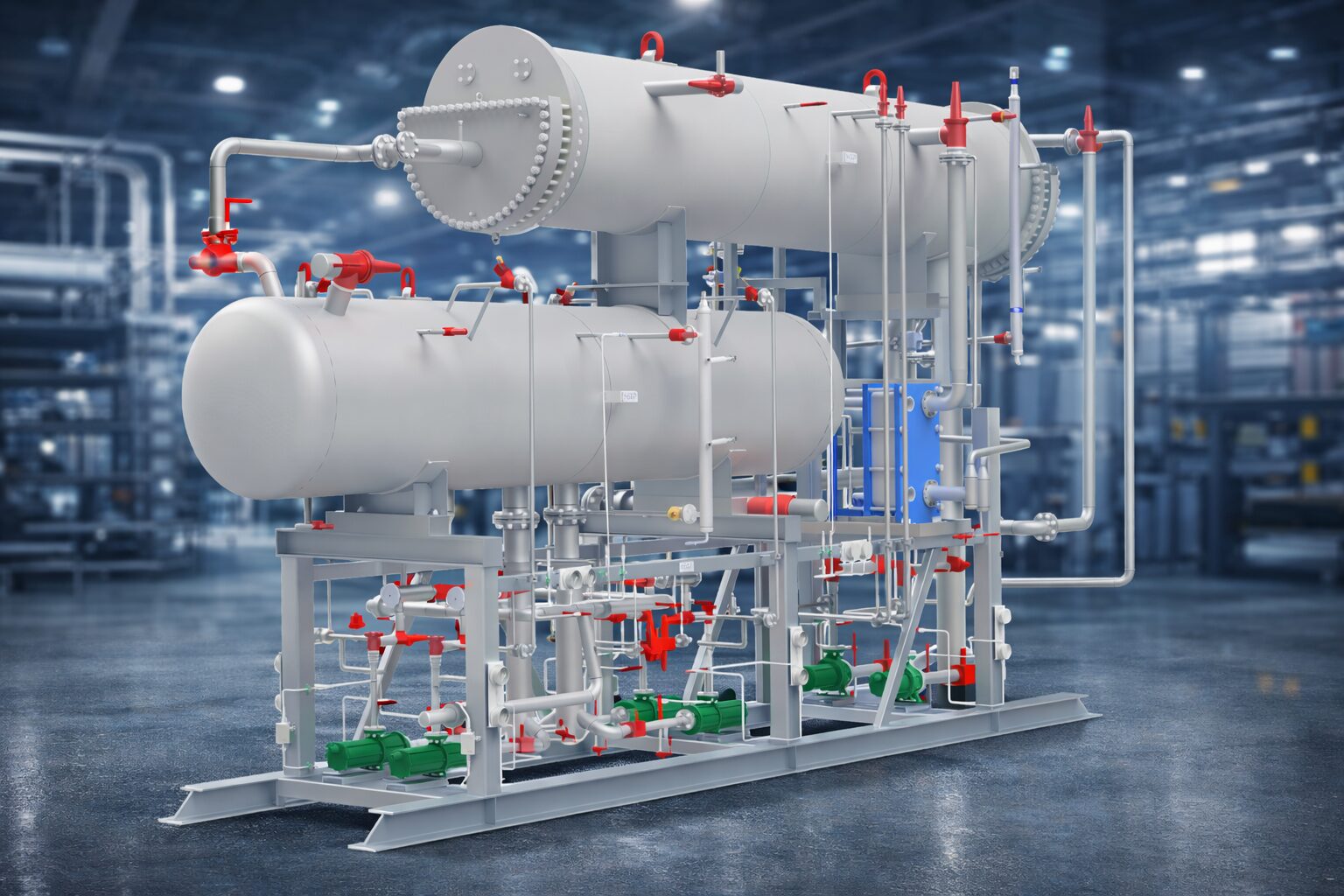
Our Flux-Hi™ Shell and Tube Spray Chillers are internationally recognized and trusted across industries. The first Flux-Hi™ system was delivered back in 1999, marking the beginning of a long-standing success story in high-efficiency cooling solutions.
In this configuration, the refrigerant evaporates in the shell, while the hot process medium is cooled inside the tubes – a design that ensures optimal heat transfer and system reliability.
Since then, we have supplied numerous systems to various industries, including distribution centers of major international supermarket chains, supporting their refrigeration needs with robust and energy-efficient technology.
Advantages over other Systems:
- Integrated Refrigerant Separator in the Flux-Hi™, no additional Separator vessel is needed
- Less Refrigerant filling then in other systems
- Because of the variable Refrigerant Level inside the Flux-Hi™ the Refrigerant filling of the whole system can be stored inside the Flux-Hi™
- Tube to tube sheet connections are double sealed and tested with a helium leak test for a high level of safety
- Unlike with Plate heat exchangers, repairs are easily possible with a short shutdown period
- Every Flux-Hi™ is custom made according to user demands; additionally we have our CAS standard range with short delivery times
- We also provide complete solutions with refrigerant vessels, valves, instruments, pumps, heat recovery and other equipment. Our complete systems are delivered pre mounted on a steel frame
Non-Destructive Testing (in-house)
We offer a wide range of non-destructive testing methods directly in our production to reliably ensure the quality and safety of your products. Our certified staff use state-of-the-art technologies to detect even the smallest defects – quickly, precisely, and in compliance with standards.
Our methods:
- Radiographic Testing (RT) – Detection of internal defects using X-ray inspection
- Ultrasonic Testing (UT) – Localization of discontinuities and bonding flaws
- Liquid Penetrant Testing (PT) – Visualization of surface cracks
- Magnetic Particle Testing (MT) – Detection of surface and weld defects in ferromagnetic materials
- Visual Testing (VT) – Qualified visual inspections by trained examiners
- Hardness Testing (UCI method) – Portable and non-destructive hardness measurement
- Helium Leak Test – Leak testing using vacuum and sniffing methods